Orbiterfinance LP shares, pool fees and redemption value
Orbiterfinance allocates liquidity-pool trading fees in proportion to each holder’s LP-token share. Your LP balance divided by the pool’s total LP supply determines that fraction. If that fraction stays constant over the fee period, multiplying it by collected fees gives the fee component of earnings. A deposit amount and an LP balance describe different quantities, so they cannot replace each other in the calculation. Ownership also differs from income: the same fraction produces different earnings when the pool collects different fee totals.
Contents
In short: Your LP balance can stay unchanged while a growing total supply reduces your fraction of the pool’s trading fees.
LP balance, total supply and collected fees
The calculation combines your liquidity provider (LP) token balance, the total supply of the same pool’s LP token and trading fees collected over a defined period. If the ownership fraction stays constant over the fee period, fee earnings equal your LP-token balance divided by the pool’s total LP supply, multiplied by its collected trading fees. Written symbolically, E = (L / S) × F. Here, L is your LP balance, S is that pool’s LP supply and F is its collected fee total.
Calculate the ownership fraction before interpreting the earnings amount. L and S must describe the same token and pool. Dividing deposited assets by an LP-token supply mixes different units. Likewise, combining LP balances from unrelated pools creates a numerator without a matching denominator. The calculation needs a positive supply; division by zero has no defined result.
Matching token units and measurement periods
Raw balances and displayed amounts
The ownership fraction has no token unit because matching units cancel in L / S. Raw contract balances and wallet displays can use different decimal scales. Where an LP token follows ERC-20, balanceOf reports an account balance and totalSupply reports issued supply. The optional decimals field specifies the display scale. Use raw values for both quantities or apply the same conversion to both. Mixing a raw supply with a displayed balance distorts the fraction, even when each individual number is correct.
Fee units and ownership periods
E retains the unit used for F. A fee total expressed in token units produces token-denominated earnings. Converting those earnings into a monetary value requires a price and valuation time. Neither belongs in the ownership fraction itself. The fee period also matters: today’s balance cannot reconstruct historical earnings if ownership changed during that period. A snapshot calculation describes its stated inputs; it does not replace the pool’s accounting of income accrued across changing balances.
Can your fee share fall while your LP balance stays unchanged?
Yes, a larger total LP supply reduces your ownership fraction when your own LP balance remains unchanged.
A growing denominator
The denominator can grow as additional LP tokens enter supply. Your token count then represents a smaller fraction of the total. This change concerns relative ownership, so it does not by itself establish a fall in the assets backing each token. Keep those quantities separate when comparing a position before and after a supply change.
Fee growth alongside supply growth
With L fixed, calculated fee earnings follow F / S. Equal proportional growth in F and S leaves that amount unchanged; faster fee growth raises it. Slower fee growth lowers it, assuming the same measurement period and valuation basis. A larger pool can therefore produce a smaller ownership percentage without producing smaller fee earnings. Neither pool size nor LP balance alone answers the income question.
Accrued fees, annual rates and execution costs
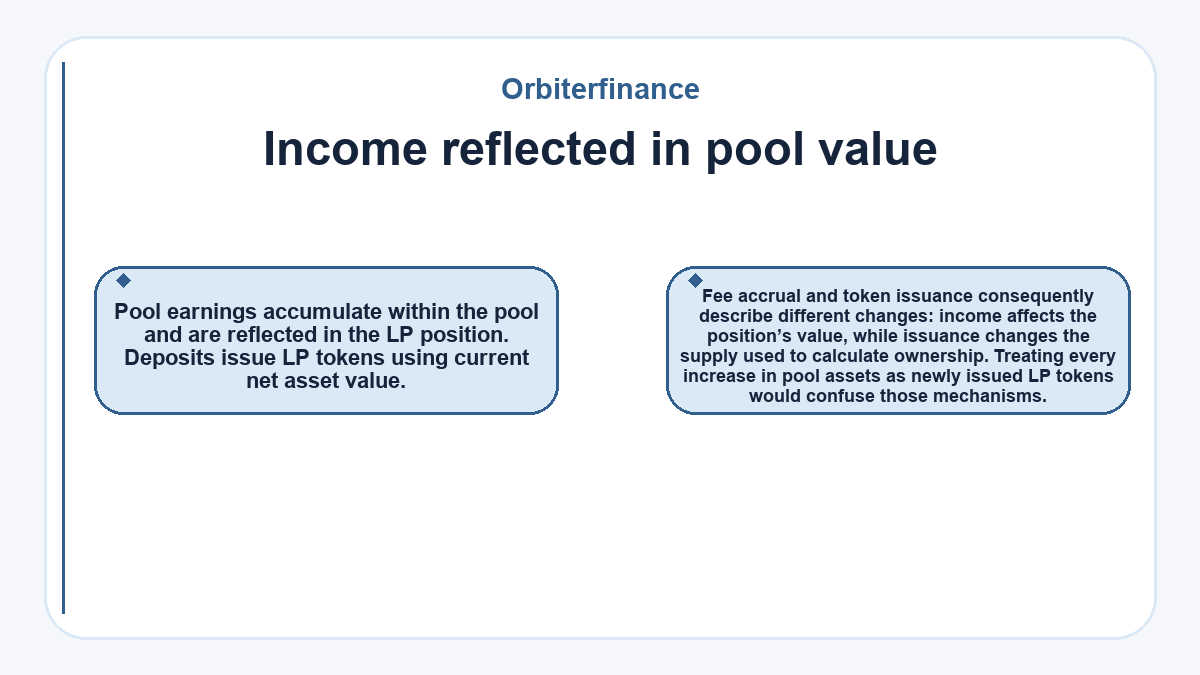
Income reflected in pool value
Pool earnings accumulate within the pool and are reflected in the LP position. Deposits issue LP tokens using current net asset value. Fee accrual and token issuance consequently describe different changes: income affects the position’s value, while issuance changes the supply used to calculate ownership. Treating every increase in pool assets as newly issued LP tokens would confuse those mechanisms.
Annual rates and net income
APR means annual percentage rate, while APY means annual percentage yield and includes compounding. The liquidity-pool APR model interpolates linearly between its minimum and maximum rates as utilization moves from zero to full utilization. Those rate bounds belong to the selected pool’s configuration. An annual rate cannot substitute for collected fees in E = (L / S) × F: a rate and an amount have different units.
The fee component also differs from net income after execution costs. Deposits and redemptions involve network transactions. Their costs need the same valuation basis as earnings before subtraction makes sense. Repeated operations can consume income even when the fee component remains positive. APY’s compounding assumption does not settle those costs or establish a fixed future fee total.
Does a calculated fee share determine your withdrawal amount?
No, redemption uses current net asset value, while the fee-share equation calculates the component attributable to collected trading fees.
Removing liquidity burns LP tokens in exchange for the assets they represent. Accumulated earnings enter that redemption value. The amount received therefore depends on the pool’s net value when redemption occurs. An earlier deposit amount cannot fix a later redemption value, and a positive fee component does not rule out losses from adverse value changes.
A claim on pool value also differs from liquidity available for immediate payment. Withdrawals cannot exceed available pool liquidity. An ownership percentage alone cannot establish whether a requested amount can leave the pool immediately.
For a meaningful return comparison, distinguish the deposited assets, redemption proceeds and execution costs. Express them on one valuation basis. Comparing a token quantity at entry with a monetary value at exit would mix incompatible measures.
Pool conditions and the alternative of holding the asset
The LP-share formula applies to the fees collected by the relevant liquidity pool. Other liquidity mechanisms have different fee recipients. OPool cross-chain transaction fees go to the maker address. A route quote can also itemize withholding, swap and transaction fees. Its total describes the route’s charges; it does not establish the fee amount accrued to an LP position.
- Use the LP balance and total supply belonging to the same pool.
- Match the ownership measurements with the fee period and keep valuation units consistent.
- Check whether an additional deposit would push total liquidity above the pool’s cap; such a deposit fails.
- Compare a requested redemption with the liquidity available for withdrawal.
- Check whether the pool is paused, since a pause prevents pool operations until resumption.
Holding the asset directly avoids the pool’s deposit and redemption operations. Providing liquidity adds participation in collected pool fees, with redemption governed by pool value and available liquidity.
Details worth knowing about Orbiterfinance
-
Does approving an Orbiterfinance pool contract give me LP tokens?
- An ERC-20 approval authorizes token spending; it does not itself create LP ownership. LP tokens arise from the liquidity deposit. The approval’s spender and allowance describe what the contract may spend, while the resulting LP balance describes your position. A successful approval therefore cannot substitute for confirmation of the deposit or its issued LP tokens.
-
Where can I find the LP balance for my fee calculation?
- You can inspect the LP-token balance through a wallet or blockchain explorer. Use the wallet address holding the position and the relevant LP-token contract on its network. Reading an ERC-20 balance uses public contract data and does not require disclosing a private key. The balance belongs to that specific address and contract.
-
How does a rounded LP balance affect the fee estimate?
- Rounding the LP balance before division can change the estimated fee amount. Whether the estimate rises or falls depends on which way the balance rounds and the precision of the supply figure. Keep both quantities on the same scale, retain their available precision through the calculation and round the final display. This preserves arithmetic precision without changing the pool’s accrual rules.
-
Will a failed liquidity deposit still consume gas?
- A deposit transaction that executes and reverts can consume gas without creating an LP position. On Ethereum, execution costs remain payable for the computation performed before a revert. A transaction rejected before inclusion has a different cost outcome because it never executes on-chain. Distinguish that execution state from an approval failure or an interface error before treating the deposit as completed.
-
Is the LP-token symbol enough to identify the pool used in my calculation?
- A token symbol alone cannot identify the LP-token contract and network needed for the calculation. ERC-20 treats the symbol as optional descriptive metadata. Use the actual contract identity when obtaining the holder balance and total supply. Matching display labels cannot make balances from different contracts valid components of one ownership fraction.